
Activities
CONTENTS
[FAIE: Economic Law] Second-Year Economic Law Students Gain Practical Experience at the People’s Court of Dong Nai Province
During the course of university study, participating in real court hearings is a valuable opportunity for Economic Law students like myself to apply theoretical knowledge to practice. Recently, I attended a criminal trial concerning a charge of murder. Drawing from the theoretical knowledge acquired in the classroom, I was able to better understand the trial process, the roles of the involved parties, and the factors influencing the court’s decisions. Through this experience, I would like to share my reflections and lessons learned, which will serve as valuable preparation for my future career in the legal field.
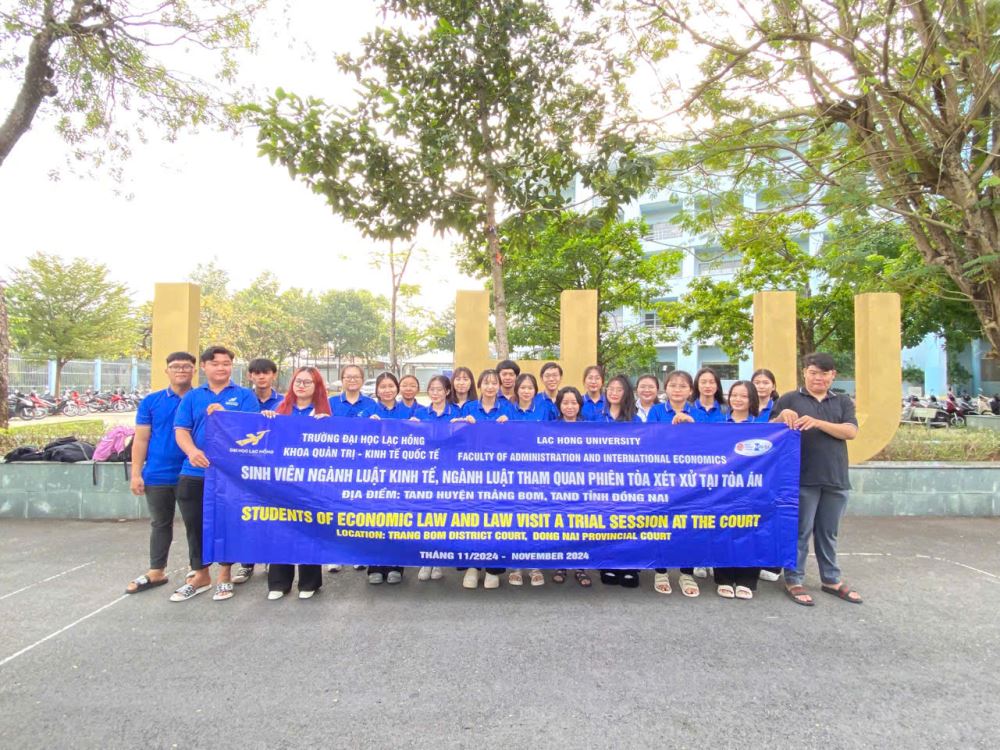
Attending the criminal trial was an extremely valuable and meaningful experience for me as an Economic Law student. On that day, my classmates and I gathered in the schoolyard, eagerly preparing to go to the court. Upon entering the courtroom, I immediately felt the solemn and tense atmosphere, which made me even more anxious and attentive.

There were three defendants in the case: two men and one woman. The two male defendants were sentenced to 14 years of imprisonment, while the female defendant received an 8-year prison sentence. This raised many questions in my mind regarding the factors that determine sentencing and how the court evaluates each situation. I learned that in criminal cases, the sentence is not based solely on the criminal act but also depends on various other factors such as motive, circumstances, and the severity of the offense.
I observed that the role of defense lawyers is extremely important. They are not only responsible for protecting the rights of the defendants but must also listen carefully, analyze the case, and present persuasive arguments to convince the judge. From this, I realized that communication and argumentation skills are key elements in the legal profession. The subtlety in their wording, questioning techniques, and rebuttals left a deep impression on me.
In addition, the judge’s conduct of the trial was noteworthy. The judge maintained a neutral and fair stance, ensuring transparency and creating an equitable space for all parties involved. I recognized that a competent judge must possess not only solid legal knowledge but also the ability to manage emotions and maintain order in the courtroom.
One important lesson I drew from this experience was the distinction between theory and practice. In textbooks, the trial process may be described in a systematic and comprehensive manner. However, in reality, many factors influence the proceedings, from the emotions of defendants and victims to the interactions among participants. Unexpected situations may arise, and the ability to respond promptly is essential to ensure that the trial proceeds smoothly.
Through attending the trial, I not only reinforced my knowledge of criminal law but also developed my observation and analytical skills. These lessons will serve as valuable assets in my future career. I feel more confident when thinking about becoming a lawyer who contributes to bringing justice to society.
In summary, the trial was not only a place to apply knowledge but also an opportunity to deeply reflect on the responsibilities of those working in the legal field. This experience has ignited in me a strong passion for the legal profession and a firm determination to pursue this path in the future.
Attending the trial also helped me recognize the close connection between theory and practice in the legal field. The knowledge I learned in the classroom—such as trial procedures, the rights and obligations of the involved parties, and legal principles—was clearly reflected in each action and decision during the trial.
However, the differences between theory and practice were equally evident. In theory, processes may appear smooth and predictable, whereas reality is often full of unexpected developments. For example, during the trial, witnesses may provide differing testimonies, which can alter the course of the case. This demonstrates that while theory provides fundamental knowledge, flexibility and adaptability in practice are indispensable.
I also realized that while theory focuses on legal regulations, practice places significant emphasis on the human factor. Emotions, motives, and personal circumstances all influence judicial decisions. This broadened my perspective on how law is not merely a set of rigid rules but also a reflection of society and human nature.
From this experience, I have drawn many valuable lessons. First, I recognized that theoretical knowledge must be applied flexibly and creatively in real-life situations. It is essential to develop analytical thinking, critical reasoning, and communication skills.
Moreover, the trial helped me better understand the responsibility of those working in the legal field. Every decision made by judges, lawyers, or witnesses can affect a person’s destiny. This realization encourages me to take my studies and self-development more seriously in order to meet the rigorous demands of the profession in the future.
Finally, the courtroom experience has further strengthened my passion for the legal field. The lessons and experiences gained from the trial are not only knowledge but also a powerful motivation for me to strive toward my academic and professional goals.
Quynh Trang – 23LU111
